Remote construction projects in Nigeria often face a practical constraint: concrete must be produced at the right rate, in the right place, and within the available working hours. Road upgrades, rural bridges, drainage channels, housing developments, and agricultural infrastructure may be located far from reliable ready-mixed concrete suppliers. Transport delays, difficult access roads, and inconsistent material deliveries can disrupt pouring schedules. A small mobile batching plant offers an alternative by combining aggregate batching, cement feeding, water dosing, and concrete mixing in a transportable production setup. However, choosing a plant based on its advertised hourly capacity alone is insufficient. Contractors need to connect production output with daily concrete demand, realistic operating time, and the sequence of site activities.
When evaluating a small concrete batching plant for sale, the central question is not simply how many cubic meters it can produce per hour. It is whether the plant can consistently supply enough concrete for the project's daily pours without excessive idle time, material shortages, or unnecessary capital expenditure. The following considerations help Nigerian contractors size equipment according to actual site requirements.
1. Calculate Daily Concrete Demand Before Selecting Plant Capacity
Plant selection should begin with the concrete quantity required for each workday. A rural road project may need concrete for culverts, headwalls, drainage structures, and selected pavement sections, while a bridge project may require concentrated pours for abutments, piers, and deck-related components. These activities produce different demand profiles. Some require modest volumes over several days; others require a substantial quantity within a limited placement window.
Estimate Volume by Construction Activity
Contractors should calculate the concrete volume for each scheduled pour using the dimensions shown in the construction drawings. For a rectangular foundation, the basic calculation is length multiplied by width multiplied by thickness. Similar calculations can be applied to slabs, columns, drainage channels, and other structural elements, with adjustments for openings, irregular shapes, and design details.
For example, suppose a remote housing project requires 36 m³ of concrete for foundations and ground beams in one day. If the planned production period is six hours, the minimum average output needed to meet the daily quantity is 6 m³/h. This is a planning baseline, not a suitable rated capacity by itself. The contractor must still account for interruptions, batch transitions, concrete testing, material replenishment, and the rate at which workers can place and compact the concrete.
Daily demand also changes as construction progresses. A small mobile concrete batching plant that serves foundation work may later supply columns, slabs, access roads, or drainage systems. Estimating both typical and peak demand helps contractors avoid choosing a plant that is adequate only for the easiest stage of the project.
Distinguish Daily Volume from Peak Pour Demand
Two projects may each consume 40 m³ per day but require different production arrangements. One may spread the volume across eight hours, while another needs most of it delivered during a three-hour structural pour. The second project requires a higher production rate and a coordinated placement crew.
Therefore, the capacity assessment should identify the largest planned pour, the permitted placement window, and the concrete placement rate. The batching plant, mixer trucks or site transport, pump where required, and placement crew must work as a coordinated system. Increasing plant output alone will not accelerate construction if the pump, transport arrangement, or workforce becomes the bottleneck.
2. Convert Rated Hourly Output into Realistic Site Production
Manufacturers generally express batching plant capacity in cubic meters per hour, but the rated figure does not necessarily represent the volume a contractor will achieve throughout a working shift. Actual output depends on batch size, mixing cycle, material feeding, aggregate moisture, operator performance, equipment layout, and interruptions. Remote sites may experience additional delays when cement deliveries, diesel supplies, or replacement parts arrive late.
Allow for Operating Efficiency and Downtime
A useful preliminary estimate is:
Realistic daily output = rated hourly capacity × productive operating hours × operating efficiency.
Assume a plant has a rated capacity of 15 m³/h and is scheduled to operate for six hours. If the contractor uses a provisional operating-efficiency factor of 70%, the estimated daily production is:
15 × 6 × 0.70 = 63 m³ per day.
The 70% factor is an illustrative planning assumption, not a universal benchmark or guaranteed result. Actual efficiency should be established from the plant's operating characteristics and site conditions. If aggregate loading is slow or material deliveries are unreliable, production may be lower. Conversely, a well-organized site with prepared materials and a steady pouring sequence may achieve better utilization.
Contractors should also avoid treating the daily estimate as permission to exceed the concrete placement schedule. Concrete must be mixed, transported, placed, and compacted within the applicable mix and project requirements. Excessive production can create waiting concrete, congestion, or material waste when downstream operations cannot keep pace.
Select a Capacity That Covers Demand Without Excessive Idle Time
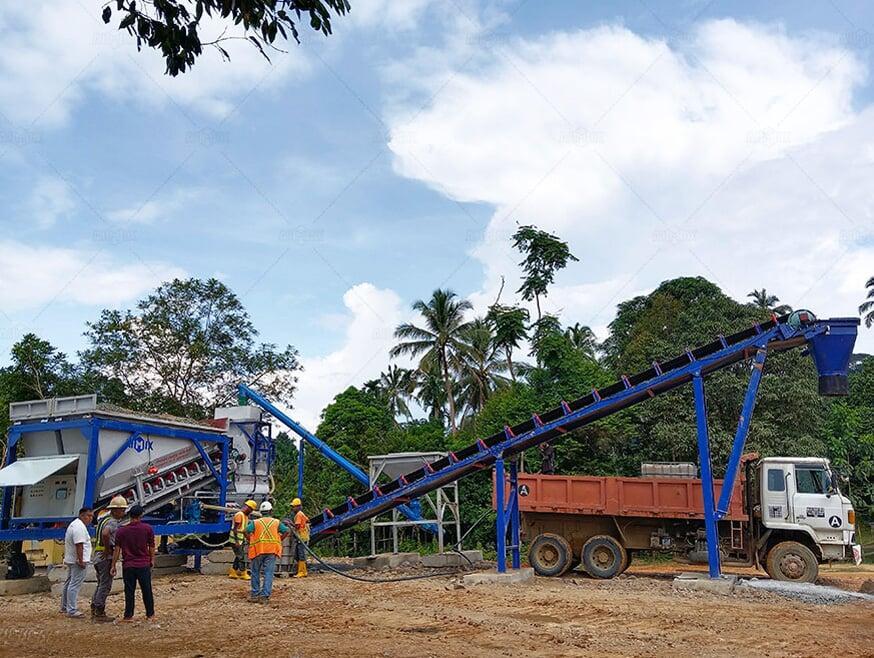
For buyers comparing a mobile concrete plant for sale in Nigeria, the appropriate capacity should reflect both routine demand and peak requirements. A smaller unit may be sufficient for intermittent drainage or residential pours, whereas larger bridge foundations or extensive infrastructure works may justify a higher-output configuration. The objective is to maintain a workable margin for interruptions without purchasing substantially more capacity than the project can use.
Before finalizing a model, ask suppliers to clarify the rated capacity basis, effective batch volume, mixing cycle, power requirements, and material-feeding arrangement. Compare these details with the required daily volume and the available production hours. A concrete batching plant for sale in Nigeria should be assessed on its practical output and configuration, rather than on its headline specification alone.
3. Match Plant Mobility and Operating Costs to Remote Nigerian Conditions
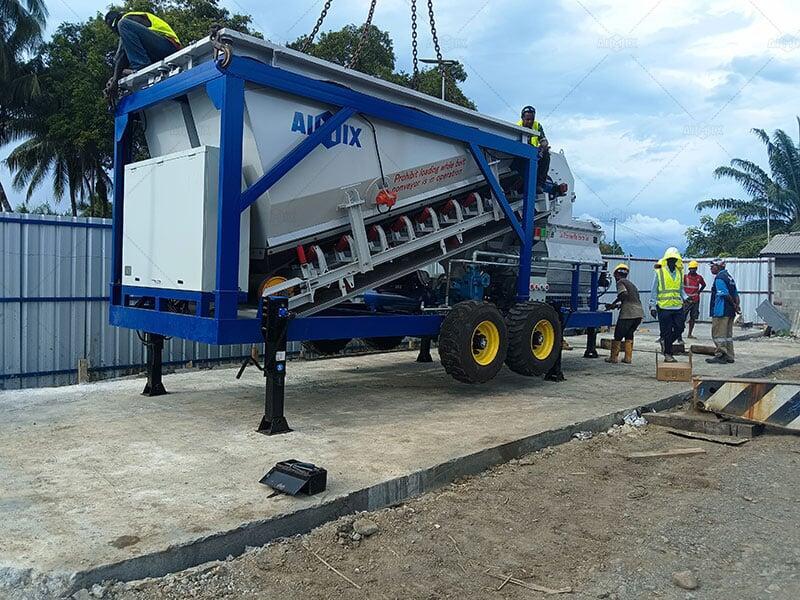
Remote-site production requires more than the correct mixer size. Transport access, foundation preparation, aggregate storage, cement protection, water availability, and maintenance arrangements can determine whether the plant operates efficiently after arrival. A portable concrete plant in Nigeria can help reduce dependence on distant ready-mix suppliers, but mobility does not eliminate the need for adequate site planning.
Check Transport, Installation, and Material Logistics
Before purchasing, confirm the dimensions and transport requirements of the complete plant configuration. Assess whether access roads can accommodate delivery vehicles and whether the site has sufficient space for aggregate stockpiles, cement storage, loading equipment, concrete discharge, and vehicle circulation. The installation requirements also need to match the available ground conditions and the manufacturer's instructions.
Material logistics deserve equal attention. Cement must be stored to prevent moisture damage, aggregates need suitable stockpile management, and water supply must be sufficient for the planned production rate. Aggregate moisture can affect the actual water added to a mix, so appropriate moisture assessment and mix-water adjustment are important for maintaining concrete consistency.
Compare Total Operating Cost, Not Just Purchase Price
A small portable concrete batching plant for sale in Nigeria should be evaluated against the project's complete operating requirements. The budget should include transport, installation, power or fuel, operators, loading equipment, maintenance, spare parts, and the cost of managing raw materials. Where the plant will serve multiple projects, relocation time and transport expense also affect its long-term value.
For short-duration projects, rental or subcontracted concrete supply may be worth comparing with ownership. For contractors managing repeated rural road, drainage, housing, or bridge works, owning a mobile plant may provide greater control over production scheduling and supply availability. The financial advantage depends on utilization, maintenance, and the distance from alternative concrete suppliers; it should not be assumed in advance.
Ultimately, selecting the right small mobile batching plant means aligning daily concrete demand, realistic hourly output, and site logistics. Nigerian contractors should calculate the largest planned pour, allow for actual operating efficiency, and verify that transport, materials, and placement equipment can support the chosen production rate. This approach turns plant capacity from a catalogue figure into a practical construction planning decision, helping remote projects maintain a more dependable concrete supply without paying for unnecessary production capability.