Self loading concrete mixers are increasingly relevant to construction projects in the USA where contractors need to produce concrete directly at the jobsite while keeping equipment and labor requirements under control. Yet purchasing a self loading mixer is not simply a matter of comparing capacity, engine power, or price. Operator requirements can also influence the real cost of ownership. Traditional concrete production may require several machines and experienced personnel to coordinate loading, batching, mixing, and transportation. A self loading concrete mixer for sale in USA consolidates these functions, while modern control and guidance features can make routine operation more manageable for operators with different levels of experience. The phrase “no expert operator required” should not be interpreted as meaning that training is unnecessary. Heavy construction machinery still requires competent operation, safety awareness, and familiarity with the equipment. The more relevant question is whether smart guidance can reduce the amount of specialized experience needed for routine tasks. In the USA, where labor availability and operating cost can strongly influence equipment decisions, this distinction can have a direct effect on project economics.
Why Operator Experience Affects Self Loading Mixer Cost
Labor Is Part of the Equipment Cost Equation
A self loading mixer combines material loading, batching, mixing, and concrete transportation into one machine. That integration can reduce the number of machines required on a construction site, but the equipment still needs a capable operator. In the USA, labor cost can represent a substantial portion of construction expenditure. If a machine requires highly experienced personnel for every routine operation, the apparent equipment price may not represent its true economic burden. Operator availability also matters. Contractors working in remote areas may have difficulty finding experienced equipment operators, while smaller companies may need one employee to perform several functions. A machine that provides clearer operating guidance can therefore have practical value beyond its purchase price.
Reducing the Learning Curve
Modern self loading mixers can incorporate joystick controls, visual indicators, automated or semi-automated functions, and straightforward operating interfaces. These features do not replace operator responsibility, but they can reduce the complexity of routine actions. For example, loading aggregates, positioning the bucket, controlling drum operation, and managing discharge can be organized through a more intuitive control system. The operator spends less time interpreting complicated sequences and more time monitoring the actual construction task. This can shorten the learning curve and potentially reduce training-related cost.
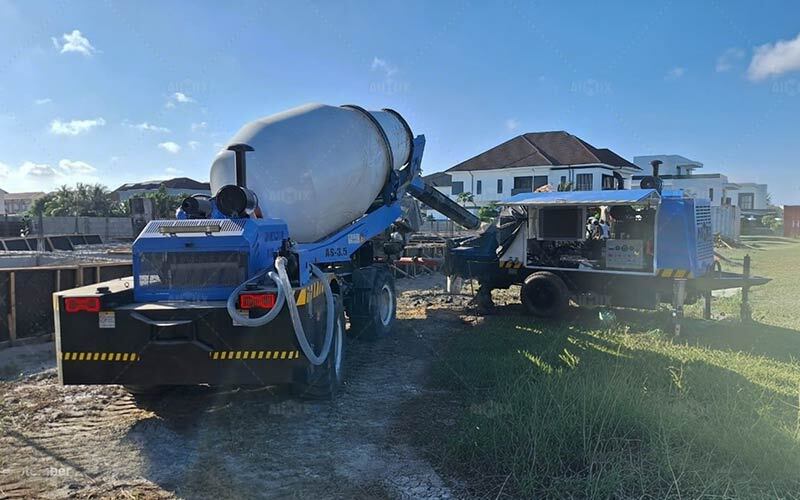
How Smart Guidance Simplifies Routine Mixer Operation
Integrated Controls Make Multiple Functions Easier to Manage
A conventional concrete production workflow may require separate personnel for aggregate loading, batching, mixing, transportation, and concrete delivery. A self loading mixer brings many of these functions into one machine. Smart guidance becomes particularly valuable because the operator is managing several functions from a single cab. Clearly arranged controls and intuitive operating logic can make this multi-function environment less cumbersome.
Guidance Rather Than Full Automation
It is important to distinguish smart guidance from full autonomous operation. The operator remains responsible for machine positioning, site awareness, material handling, and safe operation. The purpose of guidance technology is to assist decision-making and simplify repetitive controls. In practical terms, it can make the machine easier to learn and operate consistently rather than eliminating the need for human judgment.
More Consistent Operation Can Protect Concrete Quality
Concrete quality depends on accurate proportions and adequate mixing. Operator error during material loading or batching can create variations that affect the final mixture. Guided operating procedures can help operators follow a repeatable sequence. When routine operations become more standardized, the difference between an experienced operator and a newly trained operator may become less pronounced. That consistency has economic implications. Poor-quality batches can generate waste, rework, material losses, and additional labor cost. A guidance-oriented machine can therefore contribute indirectly to cost control by making routine production more predictable.
Where Simplified Operation Can Reduce Project Costs
Small and Medium Construction Projects
The economic argument is particularly relevant for smaller contractors. A large stationary batching plant may require significant infrastructure, while a conventional arrangement can require a mixer truck fleet and separate concrete equipment. A self loading mixer offers a different cost structure. One operator can perform several functions, and concrete can be produced close to the point of use. The price of the machine is only one consideration. Contractors should also examine fuel consumption, maintenance cost, labor cost, transportation requirements, and expected utilization.
Remote and Rural Construction Sites
Long distances between commercial concrete suppliers and construction sites can increase delivery cost. Traffic, road conditions, and scheduling constraints may further complicate ready-mix supply. A self loading mixer can produce concrete directly on site, reducing dependence on external delivery. This can be particularly useful for rural roads, agricultural construction, utility work, foundations, and scattered infrastructure projects.
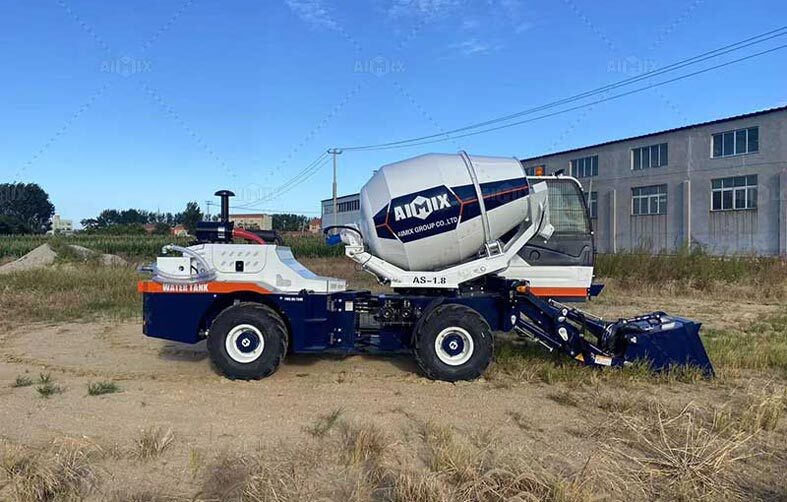
Reducing Dependence on Specialized Labor
When smart guidance makes routine operation easier to learn, contractors may have greater flexibility in assigning trained personnel. This does not mean hiring an unqualified operator; it means the equipment can be designed so that routine functions do not depend entirely on years of specialized experience. Over a project lasting several months, even modest reductions in labor cost can become significant.
What Contractors Should Evaluate Beyond the Purchase Price
Calculate Total Cost of Ownership
The lowest initial price does not automatically indicate the lowest long-term cost. Contractors should consider the complete financial profile of the machine. Important factors include:
Purchase price and financing cost
Operator labor cost
Fuel consumption
Routine maintenance and spare parts cost
Training requirements
Transportation and mobilization cost
Expected service life and resale value
Potential downtime cost
A machine with a slightly higher price may produce a lower overall cost if it requires less auxiliary equipment, fewer labor resources, and less downtime.
Match the Technology to the Actual Project
Smart guidance is most valuable when it addresses a genuine operational constraint. Contractors should not pay a premium for sophisticated features that provide little benefit in their specific working environment. The better approach is to compare price against practical value. Does the control system reduce training time? Does it simplify batching? Can one operator manage the complete workflow effectively? Does the machine reduce transportation requirements? Can it maintain reliable performance across different jobsite conditions? These questions provide a more meaningful basis for evaluating cost than the purchase price alone.
The Real Advantage Is Operational Simplicity
The future of self loading mixers is not necessarily about eliminating operators. It is about making operators more effective. For USA contractors dealing with labor shortages, variable project locations, and pressure to control cost, a self loading mini concrete mixer for sale with smart guidance can provide a useful balance between automation and human control. The machine still requires trained and responsible operation, but intuitive controls can make routine work more accessible and repeatable. Ultimately, the most economical equipment is not always the machine with the lowest price. It is the machine that converts fuel, labor, materials, and operator time into productive concrete with minimal friction. When smart guidance simplifies operation, a self loading mixer can reduce hidden cost while improving the practicality of on-site concrete production.