Boundary walls, house extensions, additional rooms, and small residential structures are common construction projects across Sri Lanka. Although these jobs may not require the concrete volumes of large commercial developments, they still demand a dependable supply of properly mixed concrete. Transporting ready-mixed concrete to every site is not always practical, particularly where access roads are narrow or projects are located outside major urban areas. A diesel self loading concrete mixer for sale combines aggregate loading, water dosing, mixing, transportation, and discharge in one machine. Contractors can produce concrete closer to the point of placement and evaluate equipment expenses against the actual cost per cubic metre.
For small and medium-sized contractors, the purchasing decision involves more than the initial machine price. Daily output, fuel consumption, operator requirements, material availability, maintenance, and equipment utilization all influence the final cost of concrete production. Understanding these factors helps contractors determine whether a self-loading mixer is a suitable investment for residential construction in Sri Lanka.
Why Use a Diesel Self-Loading Concrete Mixer for Residential Projects in Sri Lanka?
Residential construction sites often have limited working space and irregular concrete demand. A boundary wall may require several small batches over multiple days, while a house extension may involve separate pours for foundations, columns, beams, and floor slabs. A centralized batching plant or regular ready-mix delivery may not be economical for these scattered requirements.
Produce Concrete Directly at the Construction Site
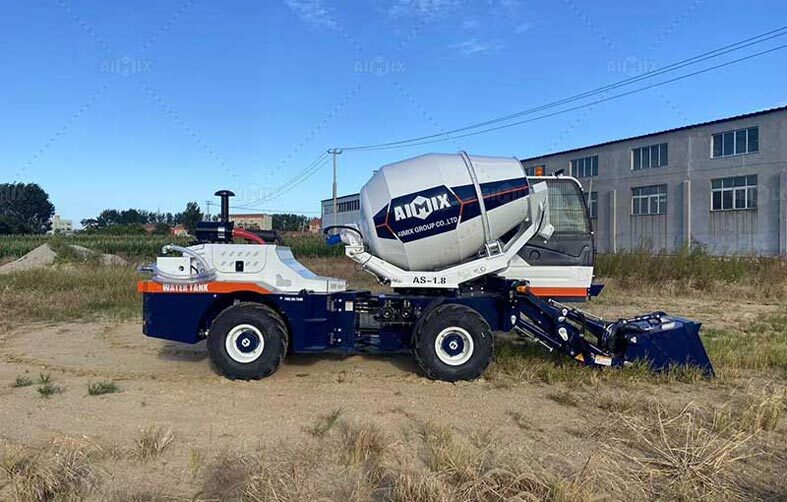
A self-loading mixer collects sand, aggregates, and other materials using its front loading bucket, doses water, and mixes the ingredients inside its rotating drum. The operator can then move the machine to the required discharge point. This arrangement reduces the need to transport separately mixed concrete from an off-site facility.
For boundary wall construction, the machine can supply concrete for strip foundations, column bases, and reinforced concrete posts. During residential extensions, it can support foundation work, lintels, ground beams, and other small structural pours. The production volume can be adjusted to the project's daily requirements rather than relying on a large delivery batch.
Diesel Power for Sites with Limited Electricity
A diesel concrete mixer for sale in Sri Lanka is particularly relevant to construction sites where a stable electrical connection is unavailable or inconvenient. Its diesel engine powers the machine's operating systems, allowing contractors to work at remote properties and developing residential locations without depending entirely on grid electricity.
However, fuel consumption should be assessed under actual working conditions. Loading frequency, aggregate moisture, site gradients, travel distance, engine condition, and operating hours all affect diesel use. Contractors should request model-specific fuel consumption information and compare it with their expected daily production.
How Much Does Concrete Cost per Cubic Metre?
The cost per cubic metre is a more useful measure of production efficiency than the machine purchase price alone. It accounts for the materials consumed, diesel, labor, maintenance, and equipment ownership expenses required to produce concrete.
Calculate the Material Cost per Cubic Metre
Materials usually represent a substantial portion of concrete production expenses. The actual cost depends on the specified concrete grade, mix design, and local supplier quotations. Cement, sand, coarse aggregates, and water should be calculated according to the quantity required for one cubic metre of finished concrete.
A practical calculation is:
Material cost per m³ = Cement cost + Sand cost + Aggregate cost + Water and admixture cost
For example, if a contractor's approved mix design requires 7 bags of cement, 0.45 m³ of sand, and 0.85 m³ of coarse aggregate per cubic metre, each quantity should be multiplied by its current delivered unit price. These figures are illustrative only; the actual mix proportions must follow the structural specification and local engineering requirements.
Include Fuel, Labor, and Maintenance Expenses
Operating expenses should be allocated according to the concrete volume produced during the same period. If a machine consumes 8 litres of diesel to produce 4 m³ of concrete, its fuel consumption is 2 litres per cubic metre. The calculation should use measured consumption rather than an assumed catalogue figure.
Other operating expenses include:
Labor: Operator wages and the labor required for material handling and concrete placement.
Maintenance: Routine servicing, lubricants, filters, hydraulic components, and replacement parts.
Equipment depreciation: The purchase cost distributed across the machine's expected productive life.
Site logistics: Internal transportation, aggregate storage, water supply, and equipment movement.
The overall calculation can be expressed as:
Concrete production cost per m³ = Material cost per m³ + Fuel cost per m³ + Labor cost per m³ + Maintenance cost per m³ + Equipment ownership cost per m³
Example of a Cost-per-Cubic-Metre Calculation
The following example demonstrates how a contractor can organize the calculation. It is not a quoted market price for Sri Lanka.
| Cost item | Illustrative cost per m³ |
|---|---|
| Materials | Rs. 24,000 |
| Diesel | Rs. 1,200 |
| Labor | Rs. 1,500 |
| Maintenance | Rs. 500 |
| Equipment ownership | Rs. 1,300 |
| Total | Rs. 28,500/m³ |
In this example, the estimated production cost is Rs. 28,500 per cubic metre. Contractors should replace these figures with local material quotations, actual fuel records, wages, and equipment costs. The resulting calculation provides a more reliable basis for comparing on-site mixing with ready-mix concrete purchases.
What Influences the Price of a Self Loading Concrete Mixer?
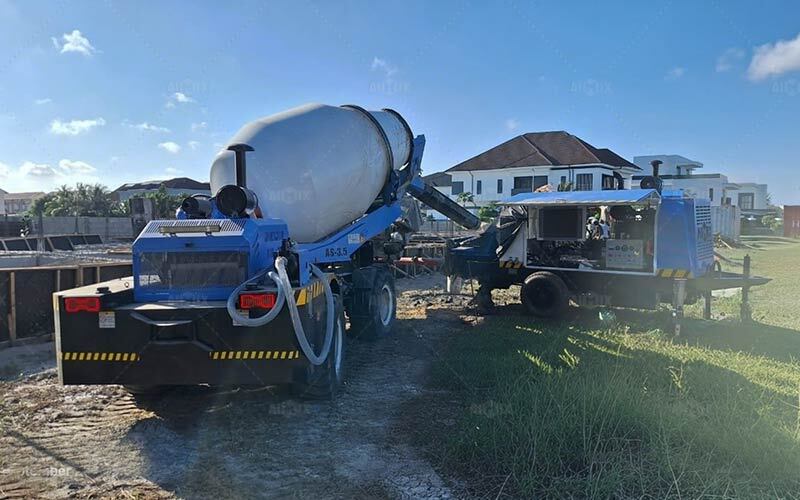
The price of self loading concrete mixer equipment varies according to its production capacity, configuration, engine, hydraulic system, and loading mechanism. A smaller model may be sufficient for boundary walls and occasional residential extensions, while contractors handling several projects simultaneously may need a machine with greater output.
Compare Capacity with Daily Concrete Demand
Equipment capacity should match the volume and frequency of concrete required. For example, a contractor building boundary walls for individual properties may prioritize compact dimensions and manageable fuel consumption. A contractor completing multiple residential extensions may place greater emphasis on drum capacity, loading efficiency, and daily production.
Nominal output should not be treated as guaranteed daily production. Actual performance depends on batch cycles, aggregate loading, travel between mixing and discharge locations, and the time needed to position and clean the machine.
Check Machine Configuration and After-Sales Support
When comparing quotations for a self loading mixer in Sri Lanka, contractors should examine more than the headline price. Engine specifications, hydraulic components, weighing accuracy, four-wheel-drive performance, and drum capacity can affect operating reliability and productivity.
Parts availability is equally important. Ask the supplier about replacement filters, hydraulic hoses, tires, wear components, and technical assistance. A lower purchase price may not represent a lower long-term cost if maintenance requires lengthy equipment downtime.
How to Select a Self-Loading Mixer for Boundary Walls and House Extensions
Assess Site Access and Working Space
Some residential properties have narrow entrances, low overhead clearances, soft ground, or limited areas for aggregate storage. Contractors should compare the machine's overall dimensions, turning radius, operating weight, and discharge height with the actual site conditions before ordering.
Match Output to the Construction Schedule
Estimate the concrete volume required for foundations, columns, beams, and other structural elements. The selected machine should supply concrete at a rate that matches the placement crew's capacity. Producing concrete faster than workers can place and compact it may create unnecessary waiting time and material waste.
Consider Local Supply and Maintenance Conditions
A self loader large concrete mixer for sale in Sri Lanka should be supported by a practical maintenance arrangement. Confirm the availability of technical documentation, spare parts, warranty coverage, and remote troubleshooting before purchase. These details are especially relevant for contractors operating outside Colombo and other major commercial centers.
Is a Diesel Self-Loading Concrete Mixer a Suitable Investment?
A diesel self-loading mixer can be a practical option for contractors handling recurring boundary wall projects, residential extensions, and other small-scale concrete works. Its integrated loading and mixing functions reduce dependence on separate equipment and allow concrete production to take place closer to the work area.
However, the investment makes the most financial sense when the machine has sufficient utilization. Contractors should estimate annual concrete demand, calculate the total ownership and operating costs, and compare the result with local ready-mix prices and delivery charges. This approach reveals whether on-site production can reduce the actual cost per cubic metre.
Get a Self-Loading Concrete Mixer for Your Sri Lankan Projects
Choosing the right machine starts with understanding project volume, site access, required output, and operating costs. Contact AIMIX with your expected daily concrete demand and site conditions to discuss suitable machine configurations and obtain a quotation for your construction projects in Sri Lanka.