The alchemy of concrete mixing has long been plagued by the specter of variability. For decades, operators relied on shovels, calibrated buckets, and the fallible “rule of thumb” to proportion aggregates, cement, and water. This methodology frequently yielded heterogeneous batches—some parched and unworkable, others perilously fluid. The introduction of the self loading cement mixer was a leap forward in logistics, yet without a robust quantification mechanism, the resultant mix consistency remained an elusive quarry. Modern construction demands a paradigm shift. Enter advanced weighing systems, which transmute a traditional volumetric loading process into a gravimetric science. By transcending guesswork, these systems engender a level of repeatability and structural integrity previously unattainable. This article elucidates how load cells and digital processors deliver superior homogeneity, reduce material waste, and enforce stringent quality assurance parameters across each rotary cycle.
The Gravimetric Imperative: Transcending Volumetric Ambiguity
Volumetric loading is inherently susceptible to variable compaction and moisture content. A “heaped” bucket of sand might deviate by fifteen percent or more in actual mass compared to a struck measure. This stochastic behavior directly undermines the water-to-cement ratio—the cardinal determinant of concrete compressive strength. Advanced weighing systems eradicate this ambiguity through the implementation of strain gauge-based load cells installed directly into the mixer’s chassis or drum support structure. These transducers convert mechanical force into an electrical signal, providing a real-time readout of the precise mass of each constituent before it enters the mixing chamber.

Mitigating the Aggregate Moisture Fallacy
One of the most pernicious sources of inconsistency is free surface moisture within sand and gravel. If an operator loads 200 kilograms of damp sand, the actual solid particulate may be only 180 kilograms, with the remainder being water that inadvertently inflates the total mix water. Advanced systems incorporate moisture probe integration, allowing the algorithm to automatically compensate for this vagary. The load cells measure the aggregate’s gross mass, while the probe quantifies the water content. Subsequently, the control unit deducts the supplementary water from the required batch liquid, preserving the targeted water-cement ratio with exacting precision.
Sequential Batching and Iterative Calibration
Sophisticated weighing platforms do not simply display a total; they facilitate sequential batching. The operator programs the desired formulation, and the system instructs the conveyor to add coarse aggregate until the first load cell target is reached. A hysteresis band prevents overshoot. Once achieved, the audible or visual cue halts the feed, and the process repeats for fine aggregate, cement, and water additive. This closed-loop feedback mechanism substantially reduces human variance. Furthermore, an interactive calibration routine using certified test weights ensures that the load cells maintain a linear response across the operational spectrum, safeguarding fidelity over thousands of working cycles.
Enhancing Throughput via Predictive Load Management
Speed is frequently counterpoised against accuracy in batching operations. Yet paradoxically, advanced weighing systems actually accelerate the consistency workflow. By precluding under- or over-loading events, the concrete mixer machine avoids time-consuming manual corrections. Moreover, modern telemetry enables predictive load management, wherein the system analyzes the trajectory of the weight curve in real time. If the feed rate is decelerating due to a clogged hopper, the algorithm can trigger an automated agitation sequence to restore flow, preventing production bottlenecks.
Dynamic Taring and Zero-Tracking Algorithms
As the mixer rotates, material can adhere to internal surfaces, creating an offset that corrupts subsequent weighments. High-end controllers employ dynamic taring functionality. The system records the incremental change following discharge, automatically resetting the zero reference point before the next batch. Zero-tracking algorithms further refine this process by ignoring minor, transient noise—such as wind gusts acting upon the frame—while flagging significant anomalies that could indicate mechanical drift or load cell failure. This ensures that every weighment commences from a verifiable tabula rasa.
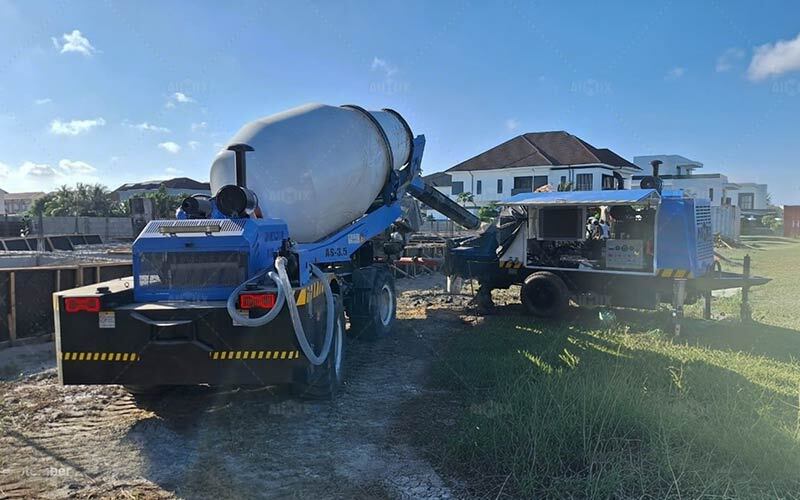
Integration with Plant-Wide Logistics
For large-scale pouring operations, a solitary self loading mixer often functions within a fleet. Advanced weighing systems feature wireless data logging, transmitting batch reports to a centralized cloud dashboard. Project managers can audit the consistency of each mixer in real time, comparing deviation metrics across shifts. Should a specific unit exhibit recurrent variability, diagnostic protocols isolate whether the issue stems from a faulty load cell, a mis-calibrated water flow meter, or operator error. This granular visibility transforms batch consistency from a nebulous goal into a quantifiable, auditable metric.
Augmenting Structural Longevity Through Precise Measurement
Consistency is not merely an aesthetic or workability concern; it directly dictates the lifecycle of the final structure. Heterogeneous concrete internal stresses non-uniformly during curing, potentiating micro-cracks that propagate under load. By enforcing a uniform water-cement ratio and aggregate gradation across every cubic meter, advanced weighing systems produce a homogenous matrix with predictable shrinkage and modulus of elasticity. This translates into superior freeze-thaw resistance and reduced permeability—a paramount consideration for infrastructural projects exposed to deicing salts or marine environments.
Durability Optimization via Admixture Metering
Modern formulations frequently incorporate superplasticizers, air-entraining agents, or retarders at extremely low dosages (e.g., 0.5% by weight of cement). Manual metering of such additives is notoriously unreliable; an excess of superplasticizer can induce segregation, while a deficit compromises slump. Advanced weighing systems feature precision micro-dosing modules for liquid admixtures, synchronized with the main load cell readouts. The injection occurs only after the cement mass is confirmed stable, and the flow rate is modulated by a flow meter under PID control. This synergy yields a robust, cohesive mixture with optimal entrapped air content and rheology.
Statistical Process Control and Reject Rate Reduction
From a quality assurance perspective, the aggregation of weighment data enables Statistical Process Control (SPC) charting. Operators can monitor running averages and standard deviations for each batch variable. When a parameter approaches the upper control limit, corrective action—such as recalibrating the load cell amplifier—occurs proactively. The consequential reduction in the reject rate offers a compelling return on investment; fewer truck returns, diminished material waste, and negligible downtime for remixing hard-set concrete inside the drum. In essence, the weighing system functions as both a prophylactic and a diagnostic instrument.