The operational paradigm for raw material processing has been fundamentally reshaped by the advent of the crawler mobile jaw crusher. This integrated machine transcends the limitations of stationary primary crushing, merging the formidable fracture force of a jaw crusher with the autonomous mobility of a heavy-duty tracked undercarriage. Its value proposition is not in being a universal tool, but in delivering decisive economic and logistical advantages within specific, demanding application spectra. The machine’s inherent capability to traverse unprepared ground and position itself directly at the material source creates a powerful operational model that eliminates costly haulage of uncrushed feed. This analysis examines the primary real-world use cases where this technology transitions from a convenient option to a critical path asset, focusing on urban demolition, primary aggregates extraction, and specialized remote site applications.
Urban Demolition and Material Reclamation
Within the dense and complex environment of urban demolition, the crawler portable jaw crusher provides a transformative solution for managing construction and demolition (C&D) waste. Traditional methodology involves demolishing a structure, loading the heterogeneous rubble onto haul trucks, and transporting it to a distant fixed crushing plant or landfill. The mobile jaw crusher inverts this process. Deployed directly on the demolition site, it processes concrete, brick, and asphalt rubble at the point of generation. This on-site processing drastically reduces the number of truck movements—a critical factor for projects constrained by traffic, noise ordinances, and limited access. The machine reduces bulky debris to a consistent, sized aggregate in a single pass, creating a valuable product from a liability.
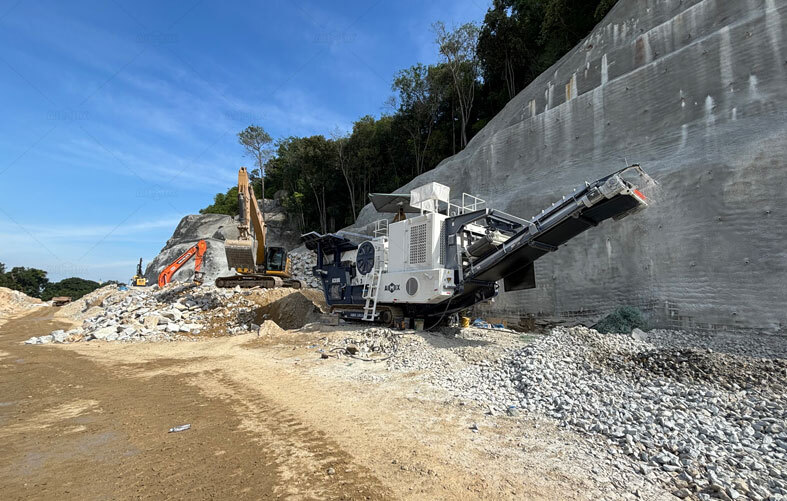
The machine’s tracked mobility and compact logistics footprint are its defining advantages in this setting. It can navigate the rough, debris-strewn terrain of a demolition site, position itself for optimal feeding by an excavator, and be repositioned as the work front advances. The ability to crush reinforced concrete, shearing rebar within the crushing chamber, is a standard capability. The processed material can be immediately reused on-site as sub-base for new construction or sold as recycled aggregate, creating a revenue stream that directly offsets demolition costs. This closed-loop material cycle, enabled by the machine’s mobility and processing power, embodies the principles of the circular economy while solving the persistent urban challenge of space, logistics, and waste disposal.
Quarrying and Primary Aggregates Production
In greenfield quarrying and aggregates mining, the crawler mobile jaw crusher serves as a highly adaptable primary reduction unit. Its primary function is to accept blasted rock directly from the muck pile, performing the initial size reduction that would traditionally be handled by a fixed jaw crusher fed by dump trucks. The economic advantage is profound: it eliminates the capital-intensive need for a primary crusher foundation, the associated feed hopper and apron feeder, and the fleet of large trucks and their operators dedicated solely to hauling uncrushed rock. The crawler unit moves to the rock, not the other way around, resulting in significantly lower cost per ton for this initial crushing stage.
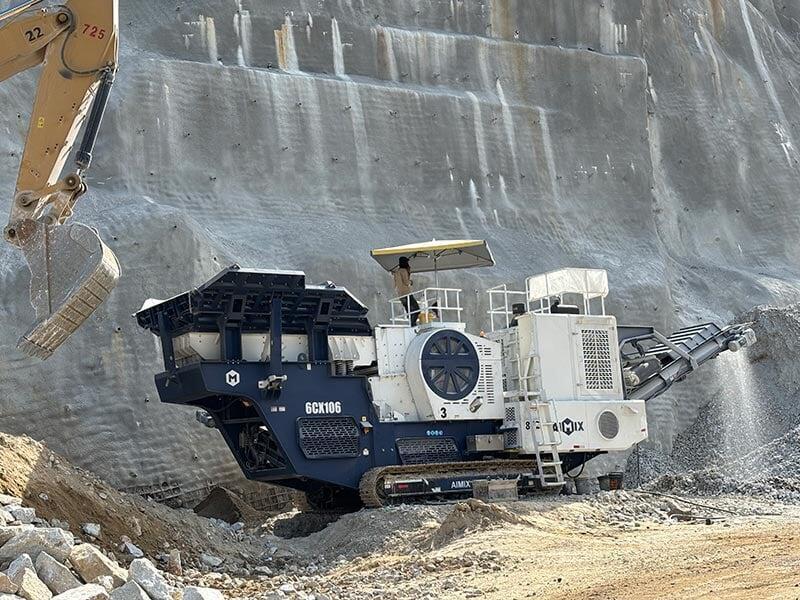
This mobility unlocks strategic flexibility in multi-pit operations or in quarries with a long, linear footprint. Instead of relying on a single, fixed primary crushing point that dictates the mine plan, a track mounted crusher can be sequentially deployed to different working faces. This allows for optimal pit development, reduces internal haulage distances for uncrushed material to zero, and enables the processing of different geological zones with minimal reconfiguration. The machine can also be used for selective mining, moving to small, high-grade pockets of material that would be uneconomical to feed to a distant fixed plant. In this context, the crawler mobile jaw crusher is not merely mobile equipment; it is a tactical production asset that introduces a new dimension of operational agility and cost control to traditional quarry engineering.
Specialized Applications and Remote Site Engineering
Beyond standard demolition and quarrying, the crawler mobile jaw crusher finds indispensable application in scenarios defined by inaccessibility or unique material challenges. For linear infrastructure projects—such as constructing highways, railways, or pipelines through remote or mountainous terrain—transporting and installing a stationary crushing plant is often impractical. A mobile crusher plant for sale can travel with the construction corridor, processing locally won rock for use as road base, embankment material, or aggregate for concrete. It enables the project to be self-sufficient for its basic aggregate needs, insulating it from the volatility and extreme cost of long-distance material supply chains.
Specialized applications also include the processing of low-grade ore stockpiles and the reclamation of old mining tailings. A mobile unit can be driven onto a stockpile, processing marginal material to a conveyable size for further treatment or sale, a task for which building a fixed plant is unjustifiable. Similarly, in disaster relief or military engineering scenarios requiring rapid runway repair or base construction, the ability to process locally available rock into usable aggregate is a force multiplier. The machine’s defining characteristic in these use cases is its operational sovereignty. It functions as a self-contained, mobile node of production, decoupled from fixed infrastructure. This makes it the optimal technological solution for frontier operations where traditional, infrastructure-heavy methods fail on grounds of cost, time, or sheer physical impossibility. It transforms isolated material deposits into immediate, on-site resources.